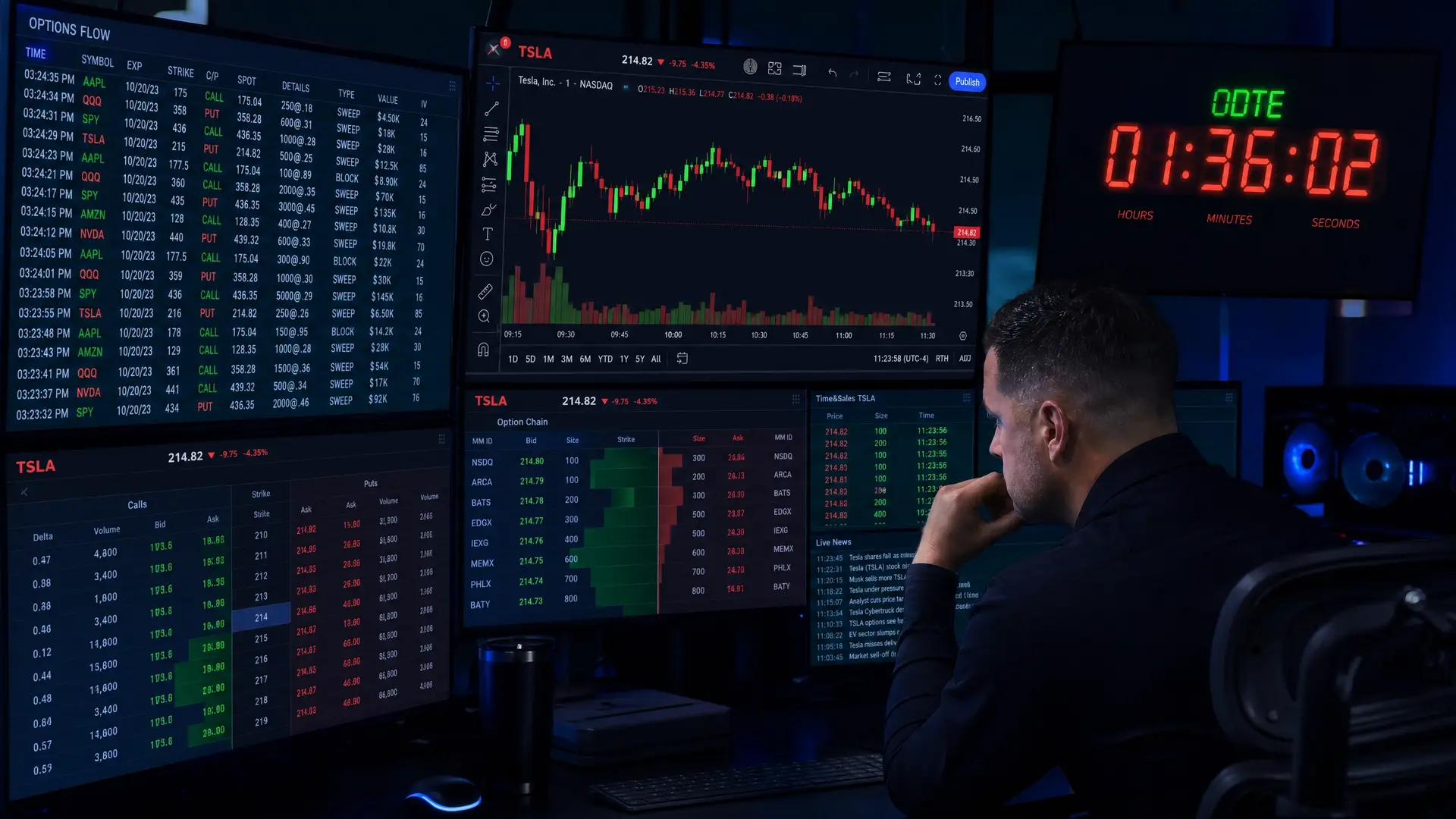
Modern financial markets are driven by a complex interplay of retail traders, institutional investors, and options market makers. One of the most explosive phenomena in the stock market today is the gamma squeeze. Unlike a traditional short squeeze, which is driven by investors buying stock to cover short positions, a gamma squeeze is fueled entirely by the mechanics of the options market — specifically, the forced hedging actions of market makers.
When retail and institutional traders aggressively buy call options, market makers are forced to buy the underlying stock to remain delta-neutral. This creates a self-fulfilling feedback loop: call buying drives stock buying, which pushes the stock price higher, which in turn forces market makers to buy even more stock. Understanding this mechanic is critical for traders looking to spot unusual options activity and capitalize on rapid price movements.
The Mechanics of a Gamma Squeeze
To understand a gamma squeeze, you must first understand the relationship between delta and gamma in options pricing. Delta measures how much an option’s price will change for every $1 move in the underlying stock. Gamma measures the rate of change of delta itself. As an option gets closer to being in-the-money (ITM) or as expiration approaches, its gamma increases significantly.
When you buy a call option, you are buying positive delta. The market maker who sells you that call option is now short delta. Because market makers are in the business of collecting premiums and bid-ask spreads — not taking directional bets on stocks — they must hedge their short delta exposure. To do this, they buy shares of the underlying stock. If a stock experiences a massive influx of call buying, market makers must buy millions of shares to hedge their risk. As the stock price rises, the delta of those call options increases (thanks to gamma), forcing the market makers to buy even more shares to stay hedged. This compounding effect is what creates the explosive, parabolic price moves associated with gamma squeezes.
For a deeper technical breakdown of how gamma and delta interact, Investopedia’s guide to gamma is an excellent reference.
Real-World Example: The GameStop (GME) Gamma Squeeze
The most famous example of a gamma squeeze occurred in January 2021 with GameStop (GME). While much of the media focused on the short squeeze aspect — where hedge funds like Melvin Capital were forced to cover their short positions — the initial explosive move was heavily driven by a gamma squeeze orchestrated by retail traders. In late January, retail traders aggressively purchased out-of-the-money (OTM) call options on GME. According to market data from January 28, 2021, traders bought roughly 1.5 million call options compared to just 178,000 put options.

| Date (Jan 2021) | GME Closing Price | Daily Price Change | Key Options Market Action |
|---|---|---|---|
| Jan 12 | $19.95 | — | Initial retail call buying begins |
| Jan 13 | $31.40 | +57.4% | Market makers forced to buy stock to hedge rising delta |
| Jan 22 | $65.01 | +51.1% | Call option volumes hit peak levels |
| Jan 26 | $147.98 | +92.7% | Super squeeze begins; put selling accelerates hedging |
| Jan 27 | $347.51 | +134.8% | Peak closing price; massive forced buying by dealers |
During the peak of the squeeze on January 27, 2021, the aggregate delta exposure became so overwhelmingly positive that market makers were forced to buy billions of dollars worth of stock in a single morning. The stock surged from $19.95 on January 12 to an intraday high of $483 on January 28 — a stunning 2,321% increase fueled largely by options market mechanics.
How to Spot a Potential Gamma Squeeze
While the GameStop event was a once-in-a-decade anomaly, smaller gamma squeezes happen regularly in the market. Traders use specific data points to identify environments ripe for a squeeze:
- A massive spike in call option volume relative to average daily volume
- Low float or low liquidity stocks where forced buying has the most impact
- Extreme put/call ratios skewed heavily toward calls
- Elevated Gamma Exposure (GEX) at key strike levels revealing gamma walls where dealers face massive hedging requirements

Tracking these metrics requires advanced options flow tools. Platforms like Cheddar Flow allow traders to monitor unusual options activity in real-time, filtering for aggressive sweep orders and identifying the exact strikes where institutional money is piling in.
Understanding Gamma Walls and GEX
Gamma Exposure (GEX) is a measure of the total dollar gamma that market makers are exposed to across all open options contracts. When GEX is strongly positive at a particular strike, that strike acts as a call wall — a price level where dealer buying pressure is so intense that the stock tends to gravitate toward it. Conversely, when GEX is deeply negative, that strike acts as a put wall, where dealer short-selling pressure creates a floor.
The gamma flip level — the price at which aggregate GEX crosses from positive to negative — is one of the most important levels for options traders to watch. Above the gamma flip, market makers are long gamma and their hedging activity dampens volatility. Below the gamma flip, they are short gamma and their hedging activity amplifies volatility. A gamma squeeze occurs when a stock rockets through a series of call walls, forcing dealers to buy at every level.

The Downside Gamma Squeeze
Gamma squeezes can also happen to the downside. If traders aggressively buy put options, market makers are forced to short the underlying stock to hedge their long delta exposure. As the stock falls, the delta of the puts increases, forcing market makers to short even more stock. A downside squeeze can also occur when an upside squeeze unwinds. Using the GameStop example, once the stock price stalled and implied volatility dropped, market makers sold off the millions of shares they had purchased, and the stock crashed back down over 80% in less than two weeks.
Understanding gamma exposure provides a critical edge in modern markets. By tracking where market makers are forced to buy or sell, traders can anticipate explosive moves before they happen. Want to see the options flow data that drives these moves? Try out Cheddar Flow free for 7 days. Learn More
Disclaimer: Options trading involves significant risk and is not suitable for all investors. You may lose the entire investment, and certain strategies may result in losses exceeding the initial amount invested. Past performance does not guarantee future results. This content is for informational purposes only and should not be considered investment advice. Always consult a financial or tax advisor before making investment decisions.