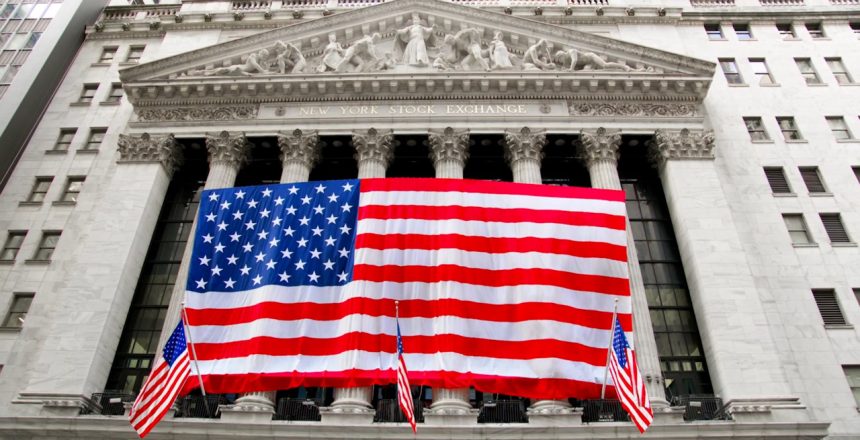
The U.S. stock market experienced a volatile week from May 5th to May 9th, 2025, as investors navigated mixed signals on trade negotiations, corporate earnings, and anticipation for the Federal Reserve’s interest rate decision. After a historic rally, major indices faced a pullback early in the week but regained momentum by Friday, driven by tech sector strength and optimism about potential trade deals.
Key Market Movements
Monday, May 5
The market halted its longest rally in nearly two decades, with the S&P 500 dropping 0.6%, the Nasdaq Composite falling 0.7%, and the Dow Jones Industrial Average slipping 0.2%. Investors grew cautious due to President Trump’s tariff remarks offering little clarity on trade war impacts, alongside Ford Motor Co.’s withdrawal of 2025 guidance, citing a $1.5 billion tariff-related hit. Palantir Technologies also disappointed with a sales forecast below expectations, contributing to the downturn.
Tuesday, May 6
Stocks continued to slide, with the Dow falling 389.83 points (0.95%) to 40,829.00, the S&P 500 shedding 0.77% to 5,606.91, and the Nasdaq dipping 0.87% to 17,689.66. Trump’s comments downplaying imminent trade deals, particularly with China, dampened investor sentiment. The Federal Reserve’s two-day policy meeting began, adding to market uncertainty.
Wednesday, May 7
Markets rebounded as the Federal Reserve kept interest rates unchanged, with Fed Chairman Jerome Powell’s press conference providing no major surprises. The Dow, S&P 500, and Nasdaq rose, buoyed by strong earnings from Walt Disney and hopes for tariff relief. However, Alphabet shares plunged, offsetting some gains.
Thursday, May 8
Stocks closed higher after Trump announced a U.S.-UK trade deal, signaling potential progress in trade negotiations. Bitcoin surged above $100,000 for the first time in three months, reflecting renewed risk appetite. The S&P 500 and Nasdaq saw notable gains, with tech stocks leading the charge.
Friday, May 9
The week ended on a positive note, with the Dow up to 41,263.74, the S&P 500 rising to 5,660.38, and the Nasdaq climbing 0.51% to 17,928.92. Tech stocks, including Tesla and Palantir, drove gains amid easing trade tensions and strong sector performance. The US500 index, however, was down 3.72% year-to-date.
Economic and Policy Highlights
Trade Developments
Uncertainty around Trump’s tariff policies persisted. Early in the week, his comments dismissing near-term trade deals with China rattled markets. However, optimism grew by Thursday with the U.S.-UK trade deal announcement and China’s openness to talks, easing fears of prolonged trade disruptions.
Federal Reserve Meeting
The Fed maintained its federal funds rate, with expectations of no cuts until at least July, as inflation remained above the 2% target at 2.8%. Investors closely watched Powell’s remarks for clues on future rate moves, but no significant shifts were signaled.
Earnings Season
The final peak of Q1 earnings saw mixed results. Walt Disney outperformed, boosting market sentiment, while Ford and Palantir faced challenges due to tariff-related concerns and weaker guidance. Overall, Q1 earnings growth remained resilient, though Q2 estimates were revised downward.
Sektor- und Aktien-Highlights
- Tech Sector: Despite early weakness, tech stocks rallied by week’s end, with Tesla, Nvidia, and Amazon among the top performers. Palantir’s 8% drop on Monday was notable, but it recovered 7.85% by Friday.
- Consumer and Industrial: Ford’s suspension of guidance highlighted tariff impacts, while Skechers and American Airlines were among the top gainers.
- Crypto and Commodities: Bitcoin’s surge past $100,000 reflected renewed investor confidence, while gold prices hit record highs as a safe-haven asset amid trade uncertainty.
Blick in die Zukunft
Investors remain focused on trade negotiation outcomes, particularly with China, as the 90-day tariff pause nears its July 8th deadline. Upcoming economic data, including the BLS consumer price index on May 13th, will provide further insight into inflation trends and potential Fed actions. Volatility is likely to persist, but sectors like financials and healthcare, less exposed to tariffs, may offer stability.