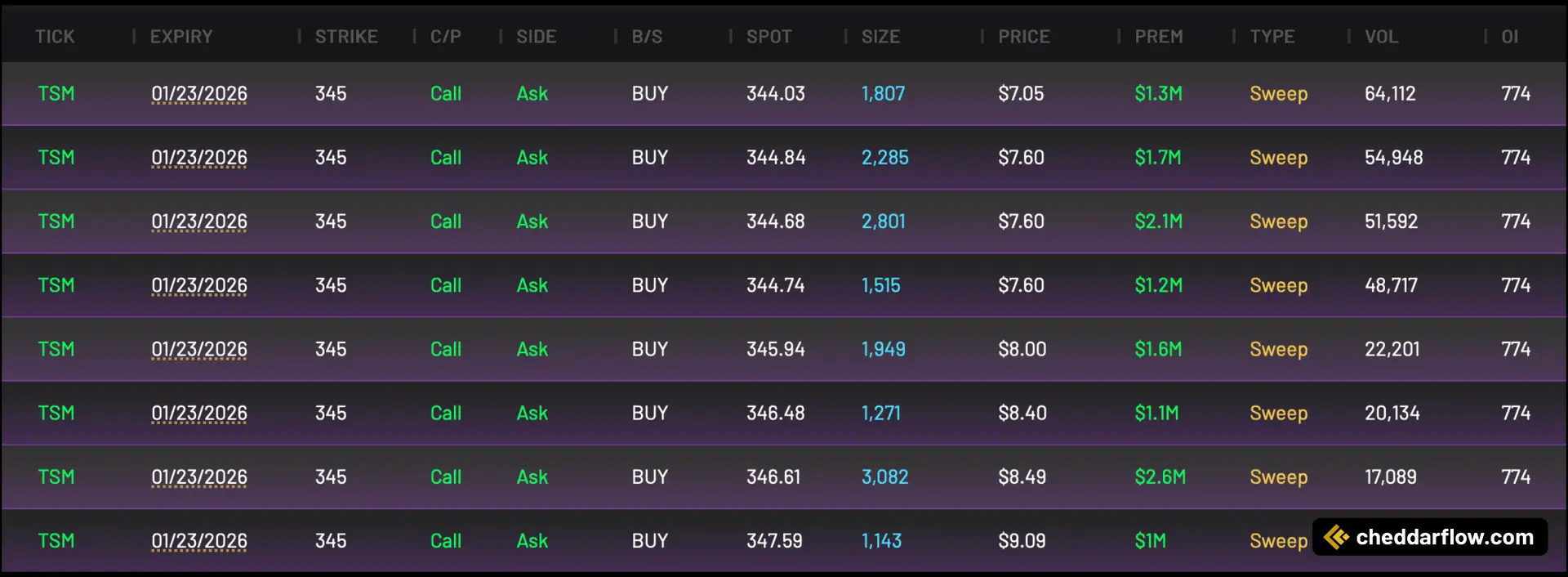
A slew of highly aggressive call sweep orders in TSM showed up today, all concentrated at the $345 call strike expiring on January 23, 2026. The expiry is roughly 8 days away from the time of execution of these trades. The most notable feature is the extreme volume-to-open-interest (V/OI) imbalance. Observing the top trade, total volume reached 64,112 contracts at the time of the trade against just 774 contracts of open interest. This results in a V/OI ratio of approximately 83x, strongly suggesting new positioning rather than traders closing existing positions.
Across multiple sweeps, traders paid between $7.05 and $9.09 per contract, translating into individual premiums ranging from about $1.0M to $2.6M, with several trades clustered in the $1–2M+ range. All orders were executed at the ask and marked as buys, reinforcing remarkable intent. The repeated sweeps at rising prices as spot moved from roughly $344 to $347+ indicate urgency and confidence, pointing to a short-term bet on TSM into the final week before expiration.
Volume and Open Interest Data
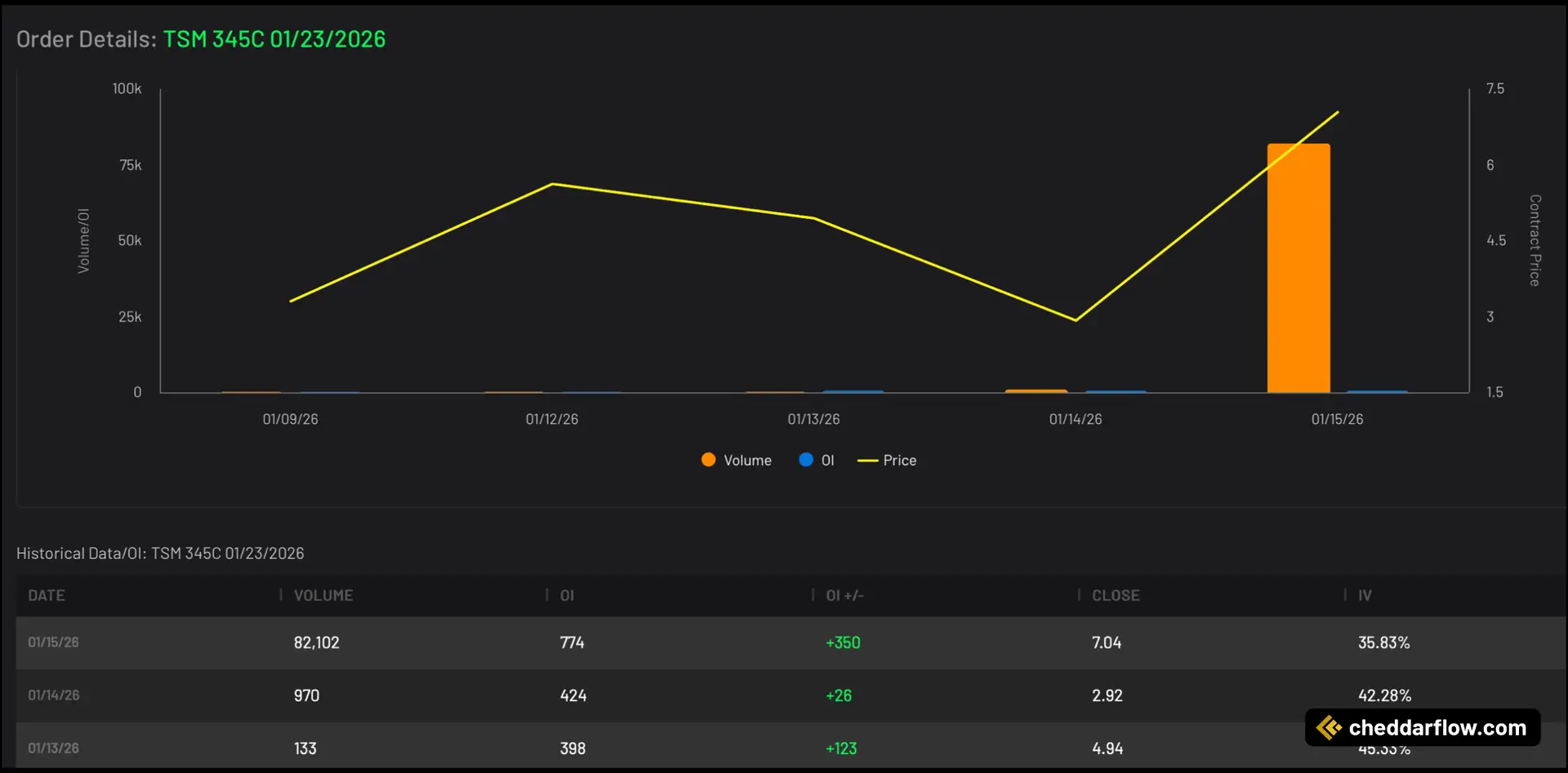
The volume and open interest chart for the TSM $345 call expiring January 23, 2026 highlights a dramatic and unusual surge in activity concentrated on 01/15/26. On that day alone, volume exploded to 82,102 contracts, while open interest stood at just 774 contracts. This confirms an extreme volume-to-open-interest imbalance and signals that the vast majority of this activity represents new positions being opened, not closures. Open interest increased by +350 contracts from the previous trading session, reinforcing the view that aggressive call buyers are establishing fresh exposure.
This surge in volume coincided with a sharp rise in the option’s closing price to $7.04, up significantly from prior days. Meanwhile, implied volatility compressed to 35.83%, suggesting strong demand rather than volatility chasing. Overall, the data points to high-conviction positioning in TSM, with traders aggressively accumulating near-term calls as expiration approaches.
Trade Side Distribution
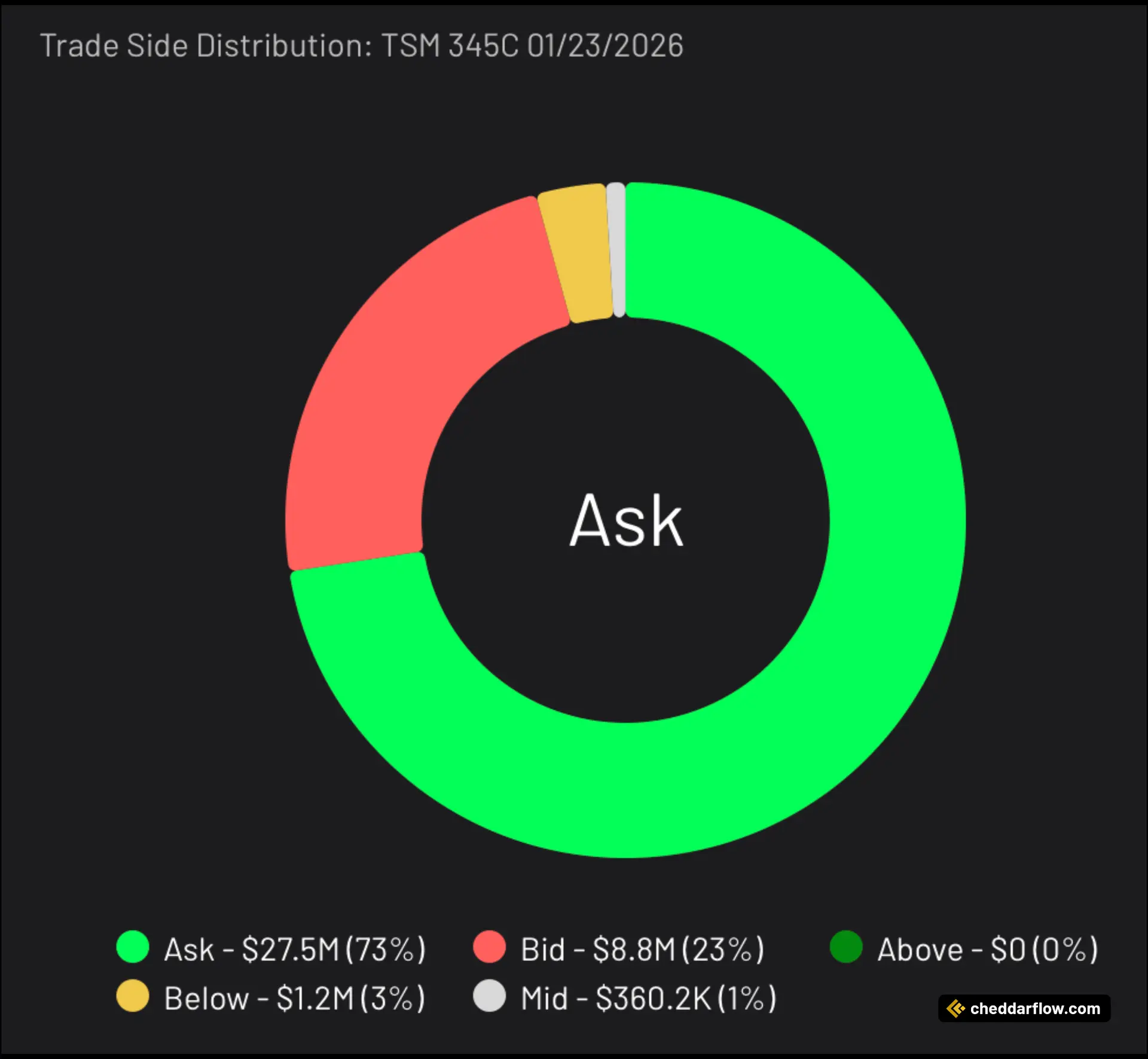
The trade side distribution for the TSM $345 call expiring January 23, 2026 shows a clear dominance of aggressive positioning. Approximately 73% of the premium, or $27.5 million, was executed at the ask. This indicates that traders were willing to pay up to secure call exposure, a strong signal of conviction.
In contrast, 23% of the premium ($8.8 million) traded at the bid, which likely reflects some profit-taking or short-term hedging but is materially outweighed by aggressive buying. Only 3% ($1.2 million) traded below the market and 1% ($360K) at the mid. Meanwhile, there was no activity above the ask, reinforcing that the bulk of flows were clean, intentional entries rather than disorderly exits.
Overall, the heavy skew toward ask-side execution strongly supports the interpretation that this was institutional-style call accumulation. This thesis aligns with the earlier surge in volume and reinforcing a decisive bias in TSM ahead of expiration.
What’s Happening with TSM
Taiwan Semiconductor Manufacturing Company (TSM) has just reported a standout fourth quarter of 2025. Revenue rising to about 33–34 billion dollars and net profit jumping roughly 35%. This surge was driven largely by surging demand for advanced AI chips and high‑performance computing products. Margins expanded strongly, with gross margin above 62% and operating margin around 54%. 7‑nanometer and below technologies contributed more than three‑quarters of wafer revenue, underscoring TSMC’s dominance in cutting‑edge process nodes.
Looking ahead, the company has guided to near 30% revenue growth in 2026 and sharply raised its capital expenditure plan to roughly 52–56 billion dollars as it ramps new capacity in the U.S., Japan, and Germany. This further signals confidence that the global AI boom will continue even as it warns that the heavy overseas build‑out will keep investment and costs elevated.
About TSM
Taiwan Semiconductor Manufacturing Company (TSM) is the world’s largest dedicated semiconductor foundry, specializing in the manufacturing of advanced integrated circuits for leading technology companies. TSM does not design its own chips; instead, it produces semiconductors for customers such as Apple, NVIDIA, AMD, and Qualcomm. This relationship establishes TSM as a critical backbone of the global technology supply chain.
The company is a leader in cutting-edge process technologies, including advanced nodes used for artificial intelligence, high-performance computing, smartphones, and automotive applications. Due to its scale, technological leadership, and central role in global chip production, TSM is widely viewed as a strategic company with significant influence over the broader semiconductor and technology markets.
Analyst Ratings
| Analyst / Firm | Rating / View | Last Updated |
|---|---|---|
| CFRA | ★★★★☆ (4 Stars) | 01/11/2026 |
| Market Edge | Long | 01/07/2026 |
| Argus | Buy | 10/16/2025 |
| Morningstar | ★★★☆☆ (3 Stars) | 10/16/2025 |
| LSEG | Outperform | 01/14/2026 |
| Schwab Equity Ratings | B | 01/14/2026 |
The analyst ratings for TSM skew decisively bullish, with most firms expressing positive or above-average outlooks on the stock. CFRA assigns a strong four-star rating, while Market Edge maintains a “Long” stance and Argus reiterates a clear “Buy” recommendation. LSEG’s “Outperform” rating further reinforces expectations that TSM will exceed broader market performance, supported by its dominant position in advanced semiconductor manufacturing.
Morningstar’s three-star rating suggests fair valuation rather than outright upside, adding a note of balance, while Schwab’s “B” grade reflects solid fundamentals with moderate risk. Overall, the consensus points to continued confidence in TSM’s long-term growth and strategic importance, even as valuation considerations temper the most aggressive optimism.
Want to see more of these trades? Try out Cheddar Flow free for 7 days. Learn More
Disclaimer: Options trading involves significant risk and is not suitable for all investors. You may lose the entire investment, and certain strategies may result in losses exceeding the initial amount invested. Past performance does not guarantee future results. This content is for informational purposes only and should not be considered investment advice. Always consult a financial or tax advisor before making investment decisions.