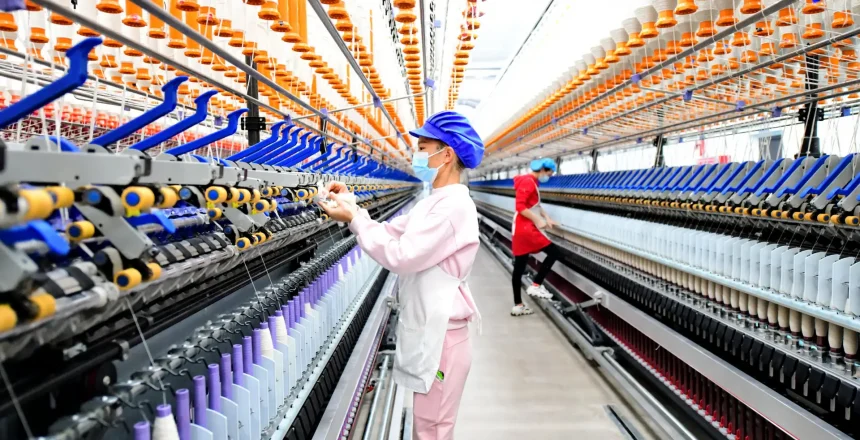
China’s industrial output continues to be a cornerstone of its economic might, driving growth and reshaping global supply chains. As 2025 unfolds, the country’s manufacturing sector not only underpins its own rapid development but also exerts profound influence on the world economy.
GDP Analysis: China vs. United States
In nominal terms, the United States maintains its position as the world’s largest economy, with a GDP of approximately $29 trillion in 2024. China follows with a GDP of around $18.3 trillion, reflecting a substantial economic scale but still trailing the U.S. by over $10 trillion. However, when assessed through purchasing power parity (PPP), which accounts for cost of living and inflation differences, China’s economy surpasses that of the U.S., reaching an estimated $35.29 trillion in 2025.
China’s Industrial Output: Recent Trends
China’s industrial sector continues to exhibit robust growth. In the first quarter of 2025, the country’s value-added industrial output expanded by 6.5% year-on-year, up from a 5.9% increase in the first two months. This growth is driven by advancements in high-tech manufacturing and equipment production, with high-tech output rising by 9.1% during the same period.
How China Became the World’s Manufacturing Superpower
China’s ascent as the “world’s factory” is the result of deliberate policy, strategic investment, and global integration:
- Policy Reforms and Special Economic Zones (SEZs): The late 1970s reforms under Deng Xiaoping introduced market-oriented changes and established SEZs like Shenzhen, attracting foreign investment and technology.
- Abundant, Low-Cost Labor: China’s vast workforce provided a competitive edge in labor-intensive manufacturing, drawing global companies to set up production facilities.
- Infrastructure Development: Massive investments in ports, highways, and power grids enabled efficient logistics and large-scale production.
- Government Support: Tax incentives, subsidies, and a favorable regulatory environment fostered industrial growth and export competitiveness.
- Currency Policy: For years, China maintained a competitive exchange rate to boost exports, making its goods cheaper on world markets.
- WTO Accession: Joining the World Trade Organization in 2001 integrated China into global supply chains, spurring an export boom.
Today, China produces more than the next nine largest manufacturing nations combined, accounting for about 35% of global manufacturing output. Its dominance is now shifting from low-cost goods to high-tech sectors, supported by initiatives like “Made in China 2025” that prioritize innovation, digitalization, and advanced manufacturing.
Conclusion
China’s industrial output remains a pillar of its economic strength and a driver of global manufacturing. Through strategic reforms, investment, and integration with the world economy, China has transformed itself from an agrarian society into a manufacturing superpower, outpacing the United States in GDP by PPP and reshaping the global economic landscape.
Sources:
- http://www.xinhuanet.com/english/2018-07/24/c_137343876.htm?utm_source=chatgpt.com
- https://www.youtube.com/watch?v=wbLGfff-YxQ
- http://english.scio.gov.cn/pressroom/2025-04/16/content_117827236.html
- https://eosglobalexpansion.com/chinas-manufacturing-industry/
- https://www.businessinsider.com/us-states-gdp-compared-countries-china-global-economy-2025-5?utm_source=chatgpt.com