चाबी छीनना
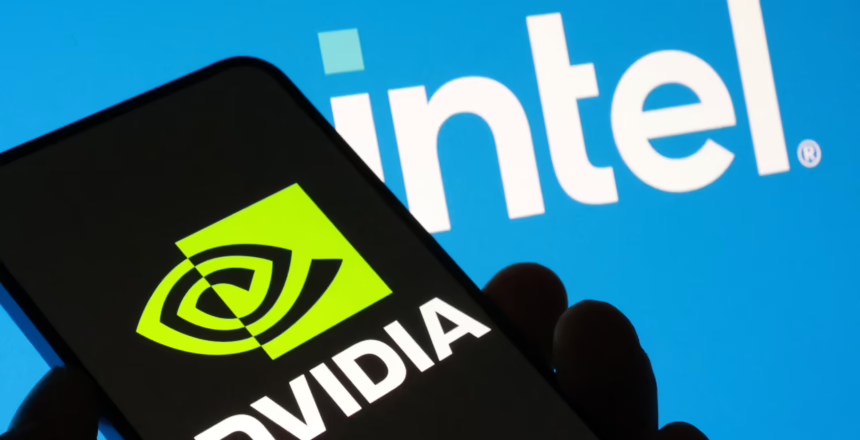
- NVDA announced a $5 billion investment into Intel, signaling a new era of collaboration in the semiconductor space.
- The move strengthens Intel’s manufacturing capabilities while giving NVDA diversification and production security.
- This partnership reshapes the competitive dynamics, especially as demand for AI processors and advanced chips intensifies.
- Both companies stand to gain resilience against geopolitical supply chain disruptions.
Why NVDA Is Investing $5B into Intel
NVIDIA’s decision to invest $5 billion into Intel highlights the changing dynamics of the semiconductor industry. Traditionally, these companies have been considered competitors, with NVDA dominating the GPU market and Intel serving as a longtime leader in CPUs. But the investment indicates a shift from pure rivalry toward strategic interdependence.
Increasing demand for computing power—fueled by AI, cloud computing, and autonomous vehicles—has led to unprecedented pressure on semiconductor manufacturing. By channeling funding into Intel, NVIDIA is ensuring that its future GPU and AI chip production won’t be bottlenecked by the industry’s well-documented supply constraints.
This investment is not purely financial. It is a bet on shared survival in a world where semiconductor resilience is becoming an essential requirement rather than an option.
Intel’s Manufacturing Boost from NVDA Investment
Intel has long aspired to reclaim its leadership in advanced chip manufacturing, particularly as it works to expand its foundry services. The $5 billion injection from NVDA will accelerate Intel’s progress by allowing more capital to flow into research, fabrication facilities, and next-generation lithography technology.
For Intel, NVDA’s endorsement serves as a credibility boost. While Intel is still catching up with cutting-edge players like TSMC in terms of fabrication, this partnership implies that significant customers such as NVIDIA see promise in its ability to scale production. This positions Intel not only as a self-sufficient CPU giant but also as a competitive foundry for third-party chip design companies.
Strategic Implications for NVDA and Intel
For NVIDIA, the investment provides more than supply guarantees: it is a hedge against overreliance on TSMC, which currently manufactures the bulk of its GPUs. With mounting geopolitical risks around Taiwan, diversifying production lines to Intel-operated fabs in the U.S. and Europe ensures a more secure supply chain.
For Intel, this relationship may increase utilization of its manufacturing lines while strengthening its relevance in the era of AI-driven hardware. Additionally, Intel’s ambition to establish itself as a global foundry could gain legitimacy if high-demand NVDA products are produced on its facilities.
The Future of AI and Semiconductor Collaboration
NVDA’s $5 billion investment into Intel suggests a broader restructuring of how semiconductor companies view competition and collaboration. Historically, silos defined the sector; today, strategic partnerships are essential. As the AI revolution drives exponential demand for advanced processors, companies like NVIDIA and Intel cannot afford to view manufacturing as a zero-sum game.
This development signals the arrival of a new era where innovation and cooperation coexist. Both companies are prioritizing the stability of global technological infrastructure, which benefits not only their shareholders but also the wider ecosystem of AI-driven industries.