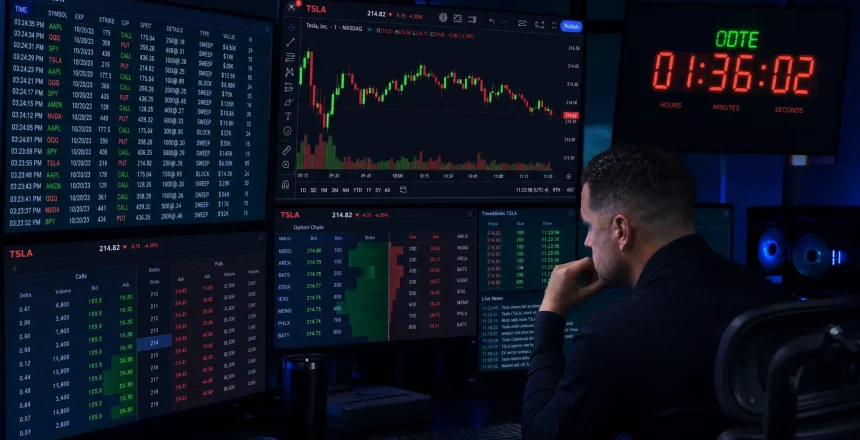
Zero days to expiration (0DTE) options have completely transformed the modern stock market. What used to be a niche trading instrument has exploded into a massive daily volume driver, now accounting for nearly 60% of all S&P 500 options traded. While many retail traders treat 0DTE options like lottery tickets—buying cheap out-of-the-money calls and hoping for a miracle—professional traders use them as precision instruments to capitalize on intraday market mechanics.
If you want to know how to trade 0DTE options consistently, you have to stop trading blindly and start tracking institutional order flow. In this comprehensive guide, we will break down the mechanics of 0DTE options, show you the exact setups to look for using real-time data, outline three distinct strategies, and provide a strict risk management framework.
The Explosion of 0DTE Volume
Before diving into the strategies, it is crucial to understand the landscape you are trading in. The introduction of daily expirations for SPX and SPY options changed the game. According to the Cboe 2025 State of the Options Industry report, 0DTE options have grown from a small fraction of the market to the dominant force driving intraday volatility.

As we covered in our previous analysis on The Rise of Zero Days to Expiration Options, this volume is not just retail speculation—it is heavily driven by institutional hedging and algorithmic trading. Because these options expire at the end of the day, their gamma profile is incredibly sensitive. A small move in the underlying stock can force market makers to aggressively buy or sell shares, creating the rapid intraday trends that 0DTE traders aim to capture.
Strategy 1: The 0DTE Reversal Trade
The most reliable way to trade 0DTE options is to wait for the morning trend to exhaust itself, then look for institutional order flow signaling a reversal. This strategy relies on identifying massive options sweeps that hit the tape when the market is overextended.
Step 1: Identify the Exhaustion
Let the market open and establish a trend. For this example, imagine SPY opens and sells off aggressively for the first two hours. Retail traders are piling into puts, assuming the market will crash all day. However, professional traders know that selling pressure eventually hits a liquidity wall.
Step 2: Watch for the Unusual Sweep
This is where order flow becomes your edge. While SPY is hitting new lows of the day, you suddenly see a massive $1.2M sweep for 0DTE At-The-Money (ATM) calls hit the Cheddar Flow dashboard. This is a glaring divergence. Why would an institution drop over a million dollars on calls expiring in a few hours while the market is dumping? Because they know the bottom is in.

Step 3: Execute and Manage Risk
Once the sweep is detected and the price action confirms the bounce, you enter the trade. Because 0DTE options suffer from rapid theta decay, you cannot hold these trades for long. The goal is to capture the violent delta and gamma expansion as market makers are forced to hedge the new institutional call buying. As we discussed in our guide on Gamma Exposure, this forced hedging is what creates the explosive upside momentum.
Strategy 2: The Trend Continuation Breakout
While reversals are powerful, catching an intraday trend continuation can be equally lucrative. This strategy focuses on buying 0DTE options when a major support or resistance level breaks, backed by aggressive order flow.
How It Works
Instead of fading a move, you wait for the market to consolidate near a key level—such as the VWAP (Volume Weighted Average Price) or the previous day’s high. If you see repeated, rapid-fire sweeps hitting the ask price just before the breakout, it signals that institutions are positioning for a continuation.
For example, if SPY is consolidating near $540 and you see multiple $200k to $500k call sweeps hitting the tape for the $541 strike expiring today, that is your cue. Once the price breaks $540 with volume, you enter the ATM calls and ride the momentum until the order flow dries up.
Strategy 3: The End-of-Day Gamma Squeeze
The final two hours of the trading day (often called “Power Hour”) are notorious for explosive 0DTE moves. As contracts approach expiration, their gamma skyrockets. This means that even a tiny move in the underlying stock can cause the option premium to double or triple in minutes.
How It Works
This strategy requires extreme discipline. You are looking for a tight consolidation range between 2:00 PM and 3:00 PM EST. If a large block trade or sweep breaks the range, market makers who sold those options are suddenly forced to hedge aggressively to remain delta-neutral.
This forced buying (or selling) creates a feedback loop known as a gamma squeeze. You enter the trade in the direction of the break, but you must use a trailing stop loss. The moves are violent, but reversals can be equally brutal if the squeeze fails.
Risk Management: Key Rules for 0DTE Success
Trading 0DTE options is not for the faint of heart. To survive and thrive, you must follow strict risk management rules:
- Never hold through chop: If the trade does not work immediately, cut it. Theta will destroy your premium if the stock goes sideways.
- Trade ATM or slightly ITM: Stop buying cheap, far out-of-the-money options. You need delta working in your favor immediately.
- Follow the smart money: Only take setups that are confirmed by massive, unusual options sweeps.
- Size appropriately: Never risk more than 1% to 2% of your account on a single 0DTE trade. The potential for a total loss (100%) is very real if you hold until expiration.
- Take profits quickly: Do not be greedy. If a 0DTE contract is up 30% to 50% in ten minutes, scale out of the position.
Frequently Asked Questions (FAQ)
What does 0DTE stand for?
0DTE stands for Zero Days to Expiration. It refers to options contracts that expire on the same day they are traded.
Are 0DTE options safe for beginners?
No. Due to rapid theta decay and extreme price volatility, 0DTE options are considered high-risk and are better suited for experienced traders who understand order flow and Greeks.
What time do 0DTE options expire?
They expire at the end of the regular trading session, which is 4:00 PM EST for most stocks and ETFs, though some index options like SPX trade until 4:15 PM EST.
Want to see these massive 0DTE sweeps in real-time before the market moves? Try out Cheddar Flow free for 7 days. Learn More
Disclaimer: Options trading involves significant risk and is not suitable for all investors. You may lose the entire investment, and certain strategies may result in losses exceeding the initial amount invested. Past performance does not guarantee future results. This content is for informational purposes only and should not be considered investment advice. Always consult a financial or tax advisor before making investment decisions.