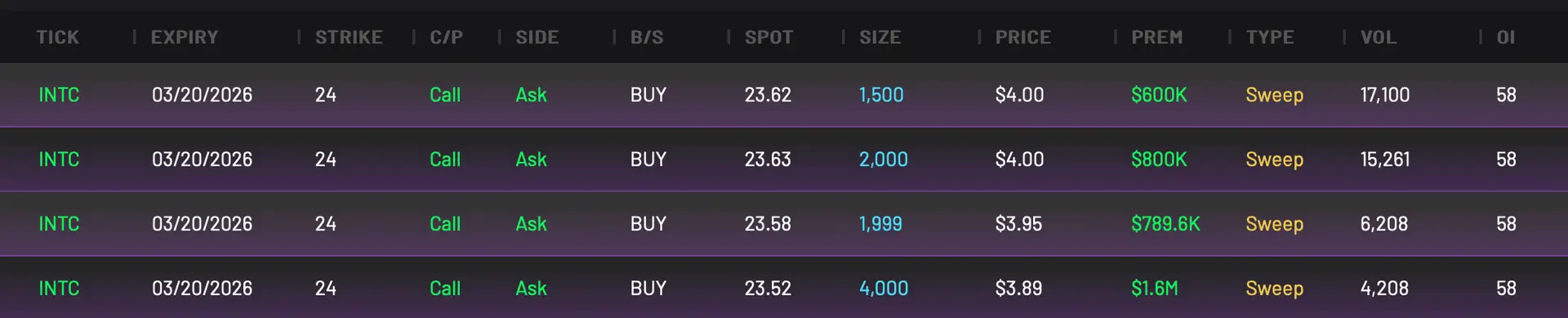
A series of large sweep call option trades on Intel Corporation (INTC) hit the tape today. The traded contracts included a $24 strike expiring on March 20, 2026—approximately 8.5 months from now. All trades were executed at the ask, indicating aggressive buying behavior. Notably, the total volume across these trades is 17,100 contracts, while the open interest (OI) stands at just 58 contracts, yielding a striking V/OI ratio of over 295. This is a powerful indicator that these are fresh positions rather than rollovers or exits.
Premiums paid range from $3.89 to $4.00, totaling over $3.8 million. The largest single premium reached $1.6 million. This level of aggressive call buying far outstrips existing positions and implies high conviction in upside movement over the medium to long term. The use of sweep orders further underscores the urgency and intent to capture liquidity across multiple exchanges without disrupting the price.
Volume and Open Interest Data
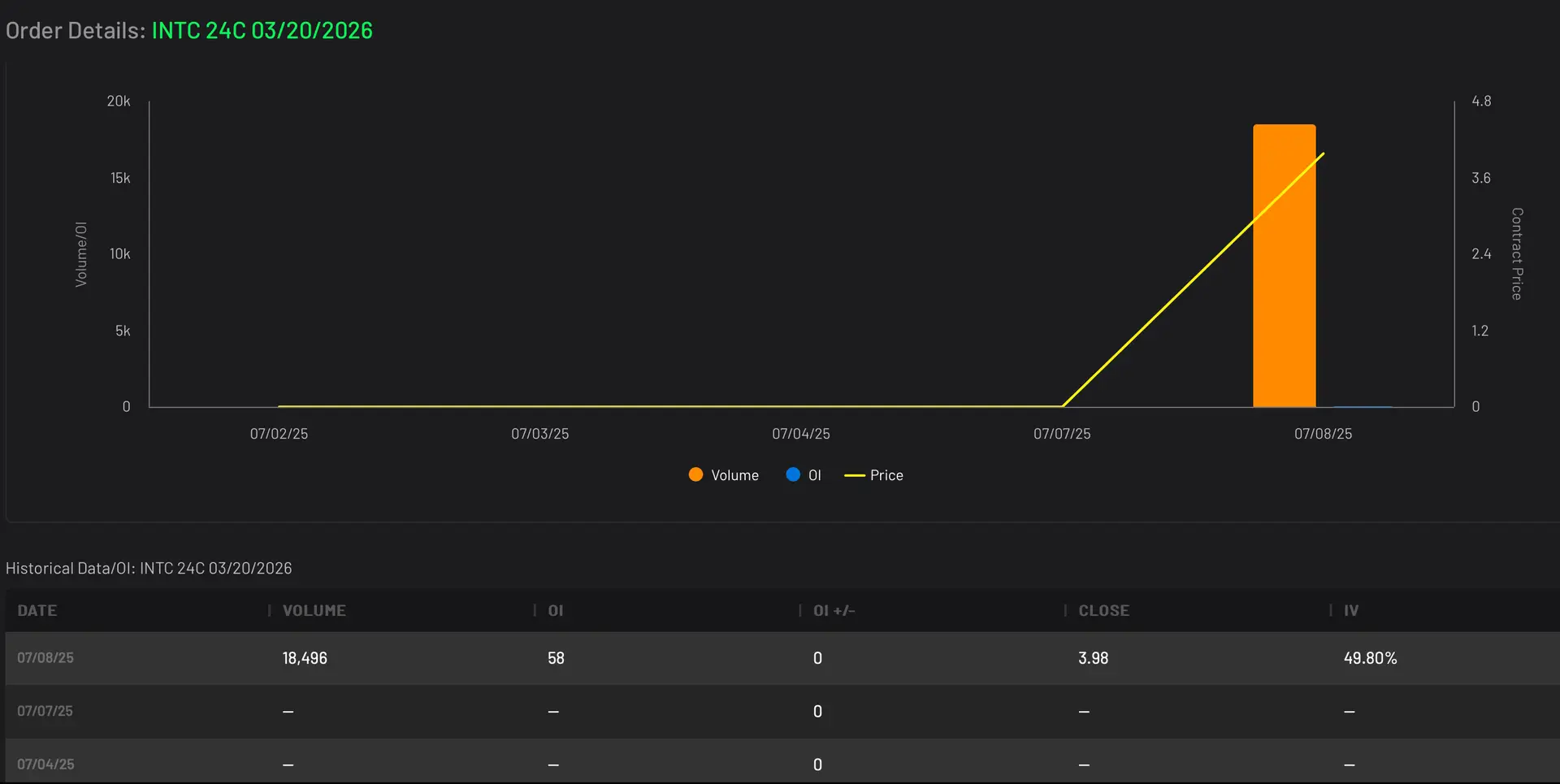
Historical data for the INTC $24 call options expiring on March 20, 2026 shows a noteworthy surge in volume on July 8th, 2025, with 18,496 contracts traded. Despite this massive spike in trading activity, the open interest (OI) remains flat at just 58 contracts. This indicates that the vast majority of these trades were initiating new positions. The unchanged OI highlights that these positions were not carried overnight, suggesting a tactical or speculative move rather than a longer-term investment.
Trade Side Distribution
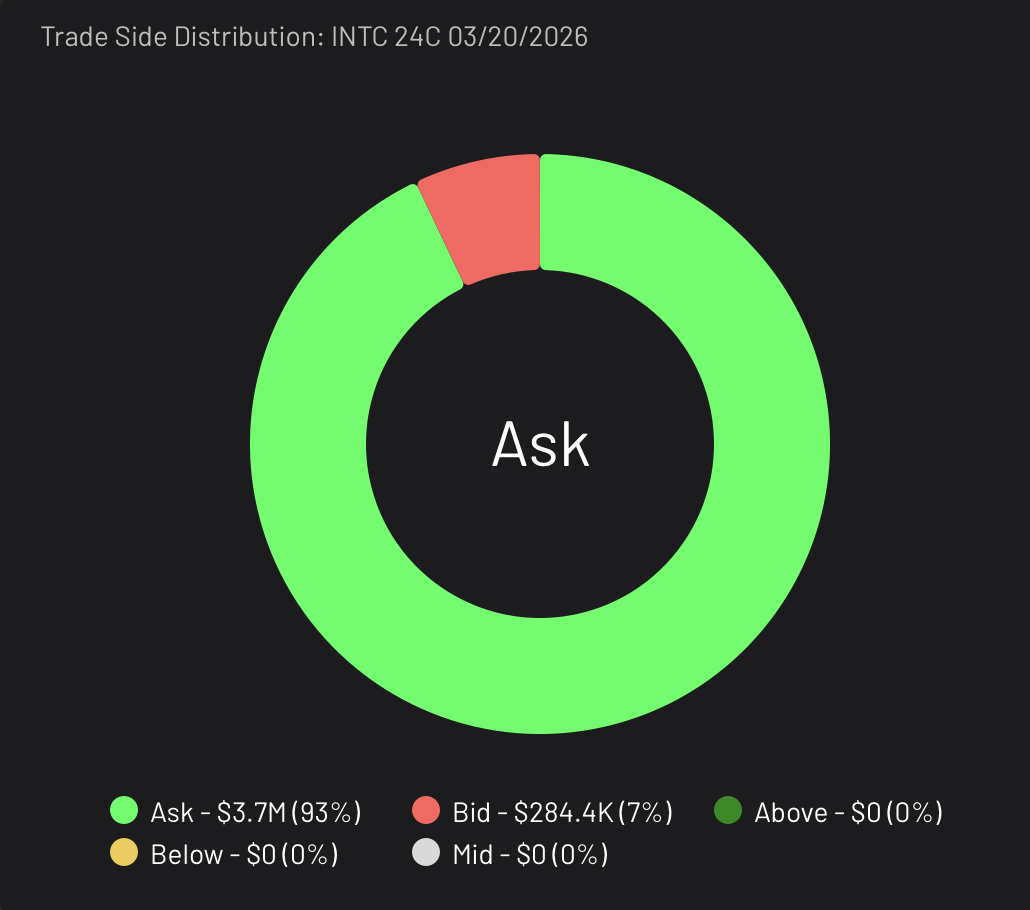
The trade side distribution for the INTC $24 call options expiring on March 20, 2026, reveals a decisively bullish order flow. 93% of the total premium ($3.7 million) was executed at the ask. This strongly suggests that buyers were aggressively seeking exposure and were willing to pay the asking price to secure positions. This further signals institutional interest or high-conviction speculation.
In contrast, only 7% of the trades ($284.4K) occurred at the bid. 0% was transacted at or below the mid, further confirming that sellers did not dominate the session. This imbalance between aggressive buying versus passive selling supports the narrative of bullish sentiment building in anticipation of a longer-term upside move.
What’s Happening with Intel
Intel Corporation (NASDAQ: INTC) is undergoing significant restructuring amid ongoing financial challenges and intensified competition in the semiconductor industry. In August 2024, the company announced plans to reduce its workforce by approximately 15%, equating to around 15,000 jobs. The decision is part of a $10 billion cost-cutting initiative aimed at streamlining operations and refocusing on core business areas.
The announcement followed a disappointing second-quarter earnings report, where Intel reported a net loss of $1.6 billion. This marks a sharp decline from a $1.5 billion profit in the same quarter the previous year. Revenue also saw a slight year-over-year decrease to $12.8 billion, falling short of analyst expectations. These financial setbacks led to a significant drop in Intel’s stock price, with shares plummeting over 19% in extended trading following the earnings release.
Leadership changes have accompanied these restructuring efforts. In December 2024, CEO Pat Gelsinger stepped down. In March 2025, Lip-Bu Tan was appointed as the new CEO. Under Tan’s leadership, Intel has announced further layoffs, including plans to reduce up to 20% of its factory workforce. The layoffs particularly target the Intel Foundry division, as the company seeks to address declining demand and challenges in the AI chip market.
About Intel
Intel Corporation is a leading American multinational technology company best known for designing and manufacturing semiconductor chips and microprocessors that power a majority of the world’s personal computers and data centers. Founded in 1968 and headquartered in Santa Clara, California, Intel pioneered the x86 architecture and has long been a dominant player in the global computing hardware space.
The company produces CPUs for desktops, laptops, and servers, along with chipsets, integrated graphics, and specialized processors for AI, IoT, and edge computing. Beyond traditional hardware, Intel is also investing in advanced technologies like foundry services, autonomous driving (through its Mobileye subsidiary), and high-performance computing solutions. Its clients range from consumer PC manufacturers to major enterprise, cloud, and government customers worldwide.
Analyst Ratings
| Analyst Firm | Rating | Last Updated |
|---|---|---|
| CFRA | ★★★ | 07/06/2025 |
| Market Edge | Long | 06/26/2025 |
| Argus | Hold | 04/25/2025 |
| Morningstar | ★★★ | 04/25/2025 |
| LSEG (London Stock Exchange Group) | Hold | 07/06/2025 |
| Schwab Equity Ratings | C | 07/07/2025 |
The analyst ratings for Intel Corporation (INTC) reflect a generally cautious to neutral sentiment across major financial research firms. Most ratings converge around a “Hold” recommendation, suggesting analysts are uncertain about near-term upside but do not see enough downside risk to recommend selling.
Specifically, CFRA and Morningstar both assign Intel a 3-star (neutral) rating, while Argus and LSEG explicitly rate it as Hold. Schwab Equity Ratings gives Intel a “C”, also indicative of a neutral stance. Notably, Market Edge stands out with a “Long” recommendation, signaling a more bullish outlook relative to its peers. No firm currently recommends a “Buy” or “Outperform,” underscoring ongoing concerns about Intel’s financial performance, strategic direction, or market competitiveness.
Want to see more of these trades? Try out Cheddar Flow free for 7 days. Learn More
Disclaimer: Options trading involves significant risk and is not suitable for all investors. You may lose the entire investment, and certain strategies may result in losses exceeding the initial amount invested. Past performance does not guarantee future results. This content is for informational purposes only and should not be considered investment advice. Always consult a financial or tax advisor before making investment decisions.